Shoulder
Shoulder pain from lifting: rotator cuff and shoulder blade work
Most lifting-related shoulder pain sits at the front or side of the shoulder and flares with pressing and reaching overhead. The usual approach is to turn the aggravating load down, not off, and to strengthen the rotator cuff and the muscles that move the shoulder blade.
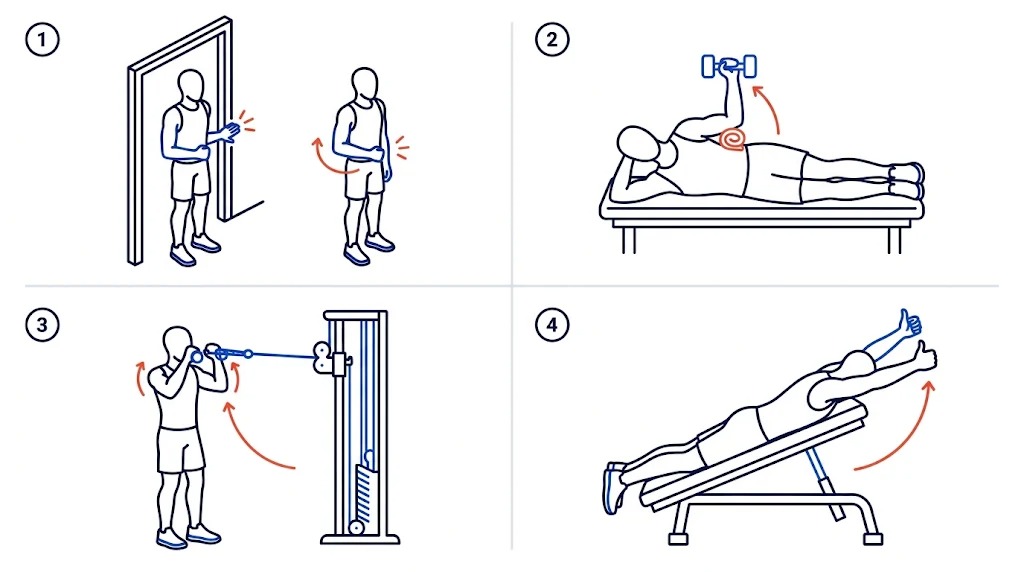
The movements
| Movement | How to do it | How much |
|---|---|---|
| 1. Isometric external rotation | Elbow at your side, bent to 90 degrees. Press the back of the hand into a wall or door frame at a moderate effort and hold. Good on irritable days. | 5 holds of 30 to 45 s |
| 2. Side-lying external rotation | Lie on your good side with a small towel under the top elbow. Rotate a light dumbbell up toward the ceiling, then lower over three seconds. | 3 × 12 to 15 |
| 3. Cable or band face pull | Pull a rope toward your face with the elbows high, finishing with the hands beside the ears and thumbs pointing back. | 3 × 12 to 15 |
| 4. Prone Y raise | Face down on an incline bench. Raise the arms into a Y with thumbs up, pause, and lower. Use very light weights or none. | 3 × 10 to 12 |
| 5. Landmine or neutral-grip press | A pressing variation that most sore shoulders tolerate: palms facing each other, or one end of a barbell anchored on the floor. | 3 × 8 to 10 |
Keeping training going
Swap to a neutral grip, shorten the range for a while (a floor press in place of a full bench press), bring the grip in, and drop behind-the-neck work. Keep the lifts that do not hurt. Discomfort up to about 3 or 4 out of 10 that settles within a day is generally acceptable; more than that means reduce the load.
When to get it checked
See a clinician promptly after a fall or a sudden injury if you cannot lift the arm, if there is visible deformity, numbness or tingling down the arm, fever, or pain that wakes you most nights. Shoulder or arm pain with chest pain or shortness of breath is an emergency.
For education only; not a diagnosis or a treatment plan. If the shoulder is not clearly improving after a few weeks, see a physician or physical therapist.