Tools
Macro calculator
Three numbers, in order: your basal metabolic rate (what your body burns at rest), your total daily energy expenditure (rest plus activity), and a macro split for your goal. Save it and every recipe page will size a portion for you.
Would rather not count? Jump to the hand-portion guide further down.
Per meal ( meals): about kcal and g protein.
Per snack ( a day): about kcal and g protein.
No snacks included: the whole day is split across your meals.
Saved in this browser. Pick a recipe and it will size a portion for you.
How it is worked out
BMR uses the Mifflin-St Jeor equation: 10 × weight (kg) + 6.25 × height (cm) − 5 × age, plus 5 for men or minus 161 for women. It is the equation most dietitians use for healthy adults.
TDEE multiplies BMR by an activity factor from 1.2 (sedentary) to 1.9 (very active). Most people overestimate their activity; if in doubt pick the lower level and adjust after two weeks on the scale.
Target calories take 20% off for fat loss or add 10% for muscle gain. Larger deficits are harder to keep and cost more muscle.
Protein is set per kilogram of bodyweight, in the 1.6 to 2.2 g range that research on resistance training supports. Fat is set at 28% of calories (a floor that keeps hormones and vitamins happy), and carbs take the rest.
Snacks are optional. Each snack you include is given about 10% of the day's calories and protein, and your meals share what is left, so the daily totals stay the same either way. With no snacks, everything is split evenly across your meals.
For education only. These are population equations, not a measurement; a pregnancy, a medical condition or a very high or low bodyweight changes the picture, so talk to a clinician or registered dietitian before a large change.
Too busy to count? Eyeball it with your hand
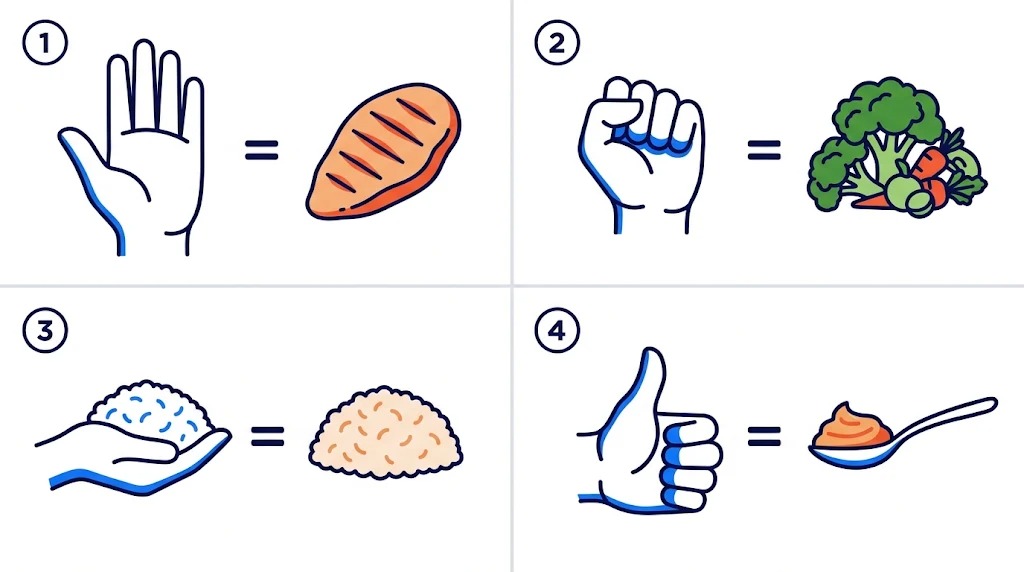
You do not have to weigh food to eat close to your numbers. Your hand is a measuring tool that is always with you and roughly scales with your body size. Four shapes cover most of a plate.
| Hand | Use it for | Roughly |
|---|---|---|
| 1. Palm | Meat, fish, tofu, eggs. The size and thickness of your palm, without the fingers. | 3 to 4 oz cooked, about 20 to 30 g protein |
| 2. Fist | Vegetables and salad. | About 1 cup |
| 3. Cupped hand | Rice, pasta, potatoes, oats, beans, fruit. | About ½ to ⅔ cup cooked, 20 to 30 g carbs |
| 4. Thumb | Oils, butter, nut butter, nuts, cheese. | About 1 tablespoon, 7 to 12 g fat |
Building a plate
At each meal, aim for 1 to 2 palms of protein, 1 to 2 fists of vegetables, 1 to 2 cupped hands of carbohydrate and 1 to 2 thumbs of fat, three or four times a day. Use the lower end if you are smaller or losing fat and the upper end if you are larger or building muscle.
Adjusting without a calculator
Give it two weeks. If your weight is not moving the way you want, add or remove one cupped hand of carbohydrate or one thumb of fat a day and watch for another two weeks. Keep the palms of protein steady.
Hand portions are a rough guide and the gram figures are approximate. If you want tighter numbers, use the calculator above and the portion sizing on each recipe page.