Back
Lower back: core endurance for lifters
Most lower back pain has no single structural cause and improves over a few weeks, and staying active helps more than resting. These movements build the trunk endurance that lets the back stay still while the hips do the work.
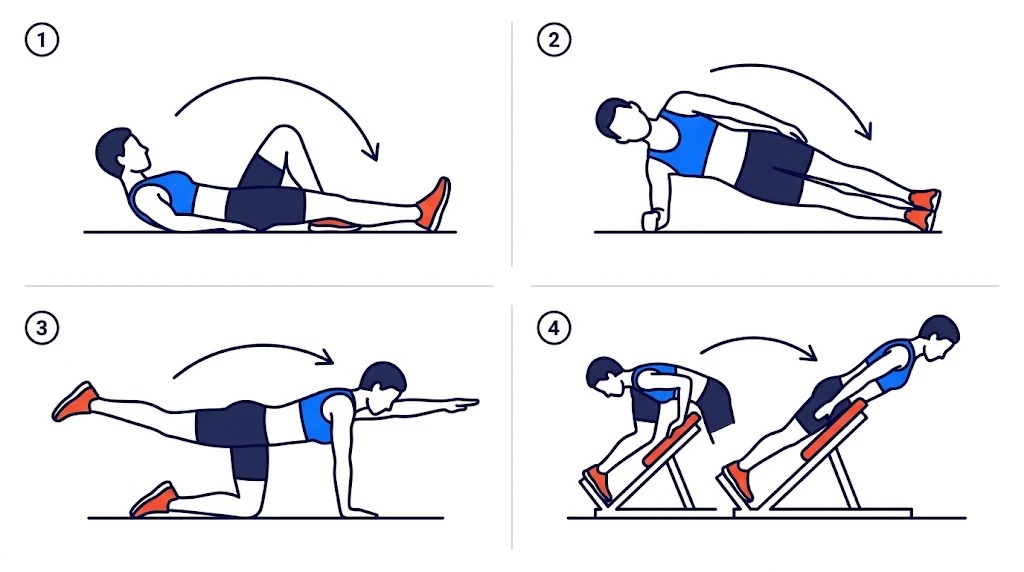
The movements
| Movement | How to do it | How much |
|---|---|---|
| 1. Modified curl-up | On your back, one knee bent, hands under the lower back. Lift the head and shoulders a few centimetres without flattening the back, and hold. | 3 sets of 5 holds, 10 s each |
| 2. Side plank | On one forearm, from the knees or the feet, body in a straight line. Short holds, repeated. | 3 sets of 4 holds, 10 s each side |
| 3. Bird dog | On hands and knees. Reach one arm forward and the opposite leg back without letting the hips rotate, hold, and swap. | 3 sets of 5 holds, 10 s each side |
| 4. Back extension | On a 45 degree bench, hinge at the hips with a flat back and come up to a straight line, no higher. Bodyweight first. | 3 × 10 to 12 |
| 5. Hip hinge drill | Hold a stick along the spine touching head, upper back and tailbone. Push the hips back and keep all three points in contact. | 2 × 10 |
How to use them
Movements 1 to 3 are often done together as a daily routine or before lifting. Movement 4 builds strength in the muscles along the spine, and movement 5 is practice for deadlifts and squats. During a flare-up, keep walking and drop the loads, not the habit.
When to get it checked
Get urgent medical help for numbness around the groin or inner thighs, new trouble passing urine or controlling the bowels, or weakness in a leg. Back pain with fever, after a significant fall, with unexplained weight loss or with a history of cancer also needs prompt assessment.
For education only; not a diagnosis or a treatment plan. If it is not improving after a few weeks, see a physician or physical therapist.