Knee
Knee pain: jumper's knee and runner's knee
Two common patterns. Jumper's knee (patellar tendinopathy) hurts just below the kneecap with jumping and deep squats. Runner's knee (patellofemoral pain) is a duller ache around or behind the kneecap on stairs, hills and long sitting. Both respond to strengthening.
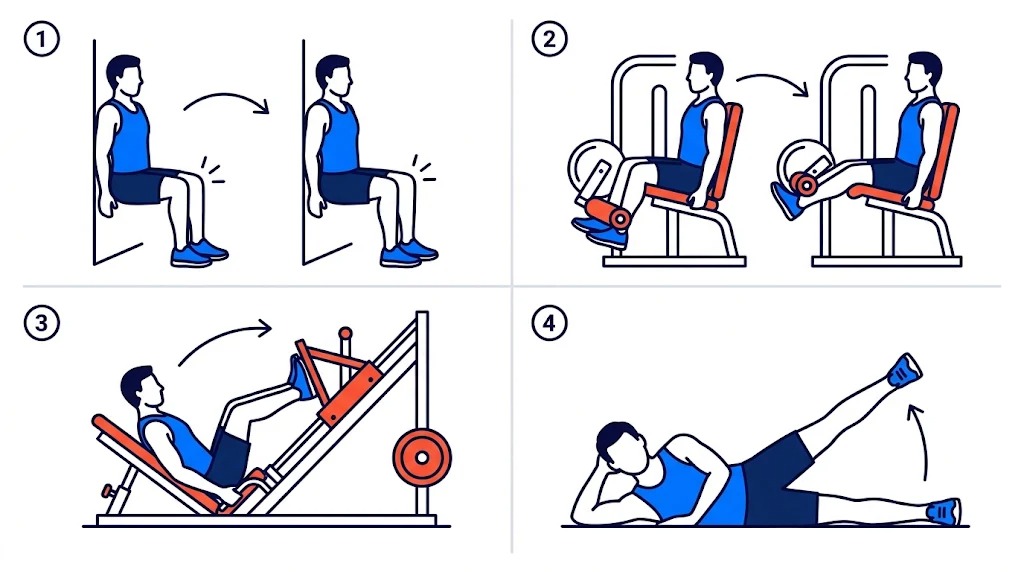
The movements
| Movement | How to do it | How much |
|---|---|---|
| 1. Wall sit or Spanish squat | Hold a half squat with the back on a wall, or leaning back against a strap fixed behind the knees. A steady hold often calms tendon pain. | 5 holds of 45 s |
| 2. Leg extension machine, slow | Three seconds up, three seconds down, through the range that stays comfortable. One leg at a time if the sides differ. | 3 to 4 × 8 |
| 3. Leg press, slow | The same tempo, feet hip-width, without locking the knees hard at the top. | 3 to 4 × 8 |
| 4. Hip abduction | Side-lying leg raises, a cable, or the hip abduction machine. Stronger hips take load off the front of the knee. | 3 × 12 to 15 each side |
| 5. Step-down | Stand on a low step and slowly lower the other heel to the floor, keeping the knee tracking over the toes and the hips level. | 3 × 8 to 10 each side |
How to use them
For pain below the kneecap, lean on movements 1 to 3. For pain around the kneecap, movements 3 to 5 matter most. Keep training the lifts and runs that stay within mild discomfort and trim the ones that do not, usually deep knee bends, jumping and downhill running.
When to get it checked
A knee that locks or gives way, swelling after a twisting injury, being unable to bear weight, or a hot swollen joint with fever all need a clinician, not an exercise sheet.
For education only; not a diagnosis or a treatment plan. If it is not improving after a few weeks, see a physician or physical therapist.