Ankle
Achilles tendinopathy: loading the tendon back to health
Usually called Achilles tendinitis, this is pain and stiffness in the tendon above the heel, worst in the morning and at the start of a run. Rest alone rarely fixes it. Progressive calf loading is the main treatment, and it takes patience.
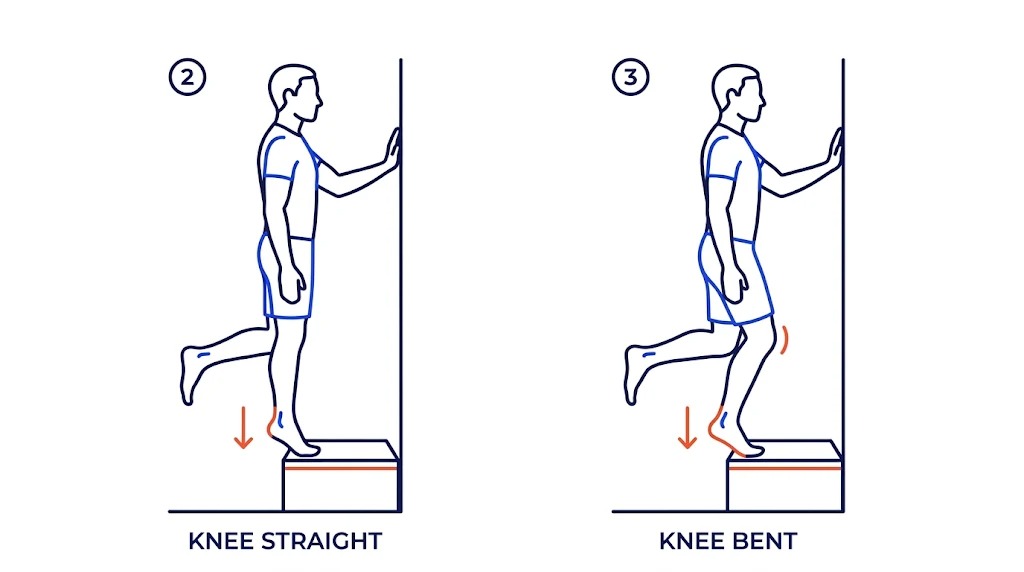
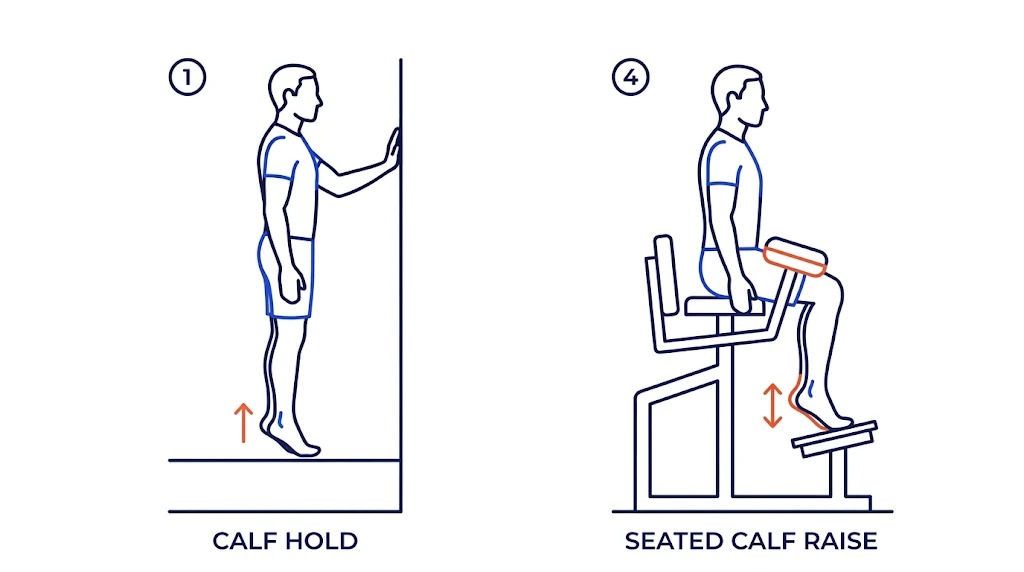
The movements
| Movement | How to do it | How much |
|---|---|---|
| 1. Isometric calf hold | Rise onto the balls of the feet and hold halfway up, on two legs or one. Useful for settling a sore tendon before training. | 5 holds of 45 s |
| 2. Heel drop, knee straight | Stand on the edge of a step. Rise on both feet, shift onto the sore side and lower slowly over three seconds until the heel is below the step. | 3 × 15, up to twice a day |
| 3. Heel drop, knee bent | The same movement with the knee slightly bent, which shifts the work to the deeper calf muscle. | 3 × 15, up to twice a day |
| 4. Seated calf raise machine | Heavy and slow: three seconds up, three seconds down, full range. | 3 to 4 × 6 to 10, three days a week |
| 5. Standing or leg-press calf raise | The same slow tempo with the knee straight. Add load as it gets easier. | 3 to 4 × 6 to 10, three days a week |
How to use them
Heel drops (movements 2 and 3) and heavy slow raises (4 and 5) are two well-studied routes; pick one and stick with it. If the pain is right where the tendon meets the heel bone, lower only to floor level, not below the step. Mild to moderate discomfort during the exercise is expected and fine if it has settled by the next morning.
Running in the meantime
Cut hills and fast running first, keep easy flat running if it stays within that discomfort rule, and build back gradually.
When to get it checked
A sudden pop or the feeling of being kicked in the calf, followed by trouble pushing off, can be a tendon rupture and needs same-day assessment. A swollen, warm, tender calf also needs urgent review. Tell your clinician if the pain began after a course of fluoroquinolone antibiotics.
For education only; not a diagnosis or a treatment plan. If it is not improving after a few weeks of consistent loading, see a physician or physical therapist.